Your Copper-Peptide Serum Has a Science Story. Let’s Get Into It
GHK-Cu may sound like the next skincare essential. Before adding another bottle, separate the ingredient, the finished product and the evidence.
You went into the shop for toothpaste. Twenty minutes later, you are comparing serums while a message asks whether you remembered the toothpaste.
One ingredient keeps catching your eye: copper tripeptide-1, often discussed as GHK-Cu.
It is reasonable to want skin care that feels good and fits your budget. You do not need to turn a quiet five-minute ritual into a second job.

Why researchers are interested
In a foundational laboratory study, GHK-Cu stimulated collagen synthesis in cultured fibroblasts, cells involved in connective tissue. That helps explain the scientific interest in copper peptides. It was a cell experiment, not proof that a particular serum smooths wrinkles. Maquart et al.: GHK-Cu and collagen synthesis in cultured cells
The next question is what happens in people using a finished product. Formulation, how the product is used, the participants and the outcome measured all matter. An ingredient’s promising backstory cannot answer every one of those questions.
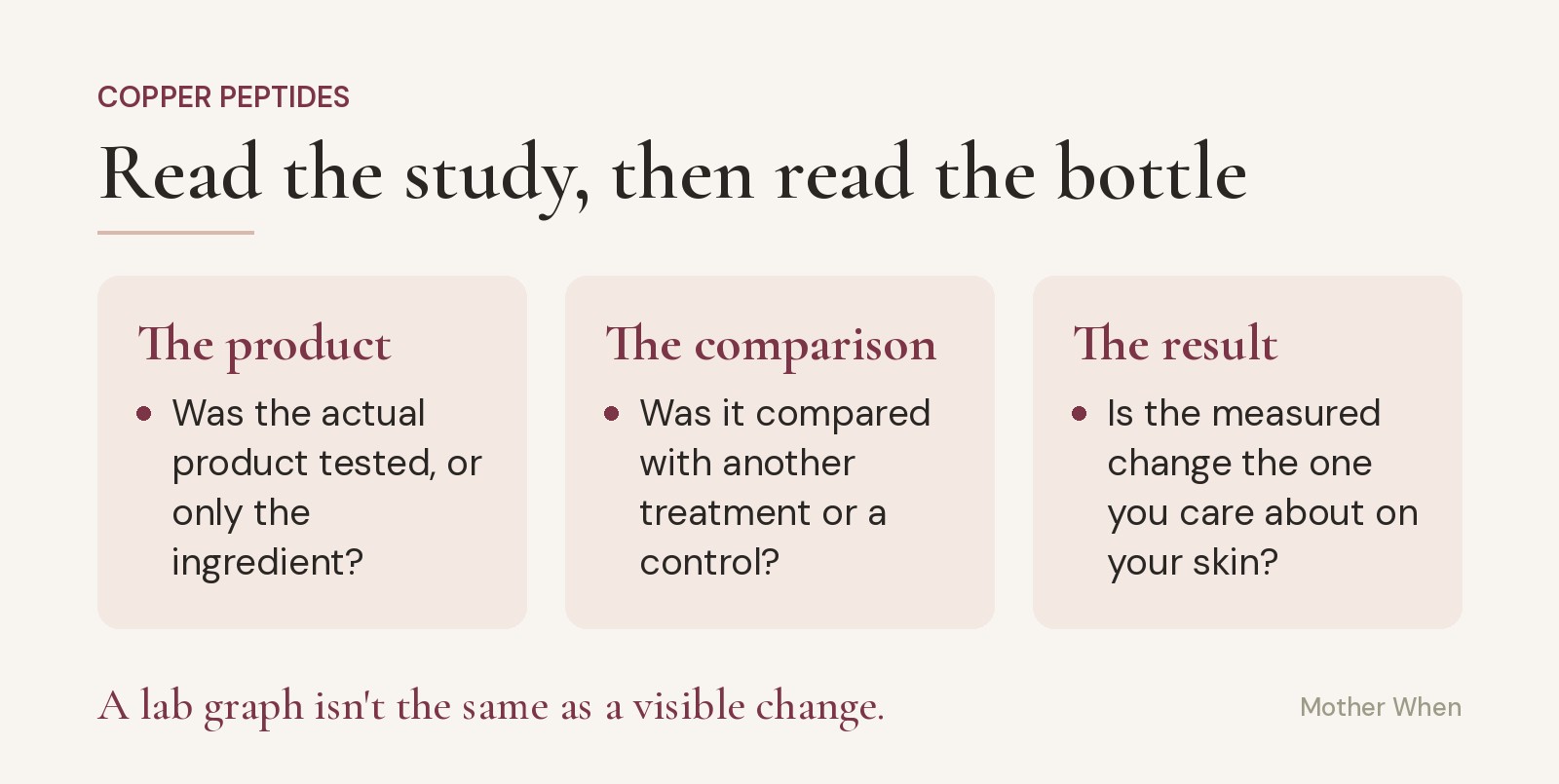
Read the study, then read the bottle
Ask whether the actual product was tested, how it compared with another treatment or a control, and whether the measured change is the one you care about. A dramatic-looking laboratory graph may describe something very different from a visible change in your skin.
Topical skincare findings also cannot establish the safety or effectiveness of injected compounds. A research powder is not a home-formulation shortcut. Do not add laboratory materials to your skincare or treat a research catalog as a source of stronger cosmetics.
Keep the routine manageable
The American Academy of Dermatology recommends starting with basics such as sunscreen and moisturizer and choosing products suited to your skin. You can build from there according to your goals and budget. American Academy of Dermatology: Selecting skin care products
Before buying another bottle, ask yourself:

- Am I trying to solve a specific concern, or reacting to a dramatic promise?
- Does this fit the routine I will realistically maintain?
- Would advice from a dermatologist be more useful for a persistent problem?
You are allowed to enjoy a serum without expecting it to transform your life. You are equally allowed to put it back, buy the toothpaste and spend those five minutes doing something else you like.
Research worth reading
- Maquart et al.: GHK-Cu and collagen synthesis in cultured cells. Laboratory study: a positive collagen-synthesis finding in cultured cells explains research interest without proving a finished skincare product’s performance.
General education, not personal medical advice. Discuss health concerns and treatment decisions with a qualified clinician. Selected research examples illustrate encouraging findings and their limits; they are not a complete review of benefits and risks.
Read next
 Beauty & Self CareGHK-Cu, the Copper Peptide: When Did I Start Hiding From Family Photos?A familiar moment behind the camera opens a careful look at GHK-Cu, topical skincare research, and the limits of a compelling ingredient story.
 Beauty & Self CareSkin Care After 35: What Matters and What Is Marketing?Your face hasn’t missed a deadline. Learn which basics earn their place, what peptide claims mean, and when another bottle isn’t the answer.
 Beauty & Self CareA Simple Skincare Routine for a Very Full DayKeep the useful basics, spend deliberately and make everyday skincare easier to reach on an ordinary busy morning.
Get the weekly digest
One email a week. Unsubscribe anytime. Privacy Policy
More in Beauty & Self Care

Peptides in Beauty and Wellness: Why Moms Are Paying Attention
From copper-peptide serums to major medical breakthroughs, explore the encouraging science behind a very small molecule with a big story.

When Did Getting Dressed Stop Feeling Fun?
The jeans pinch, the clock is ticking, and nothing feels like you. A small wardrobe reset can make getting dressed feel personal again.
Discussion
Loading comments…