Snacks · Unpublished recipe draft
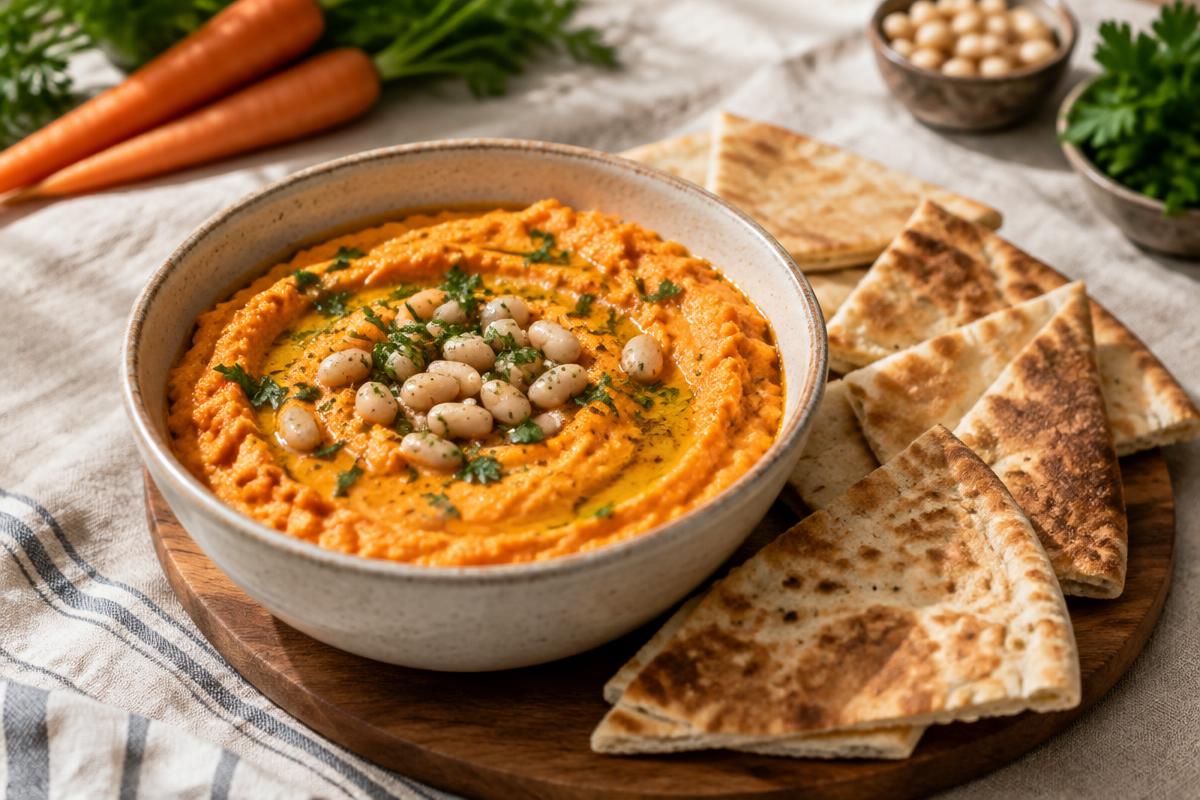
Carrot and White Bean Dip with Pita
This soft orange dip uses everyday beans and carrots, with no tahini to track down. Put the pita beside it and let everyone decide how much dipping they want to do.
Original AI-assisted recipe drafts prepared for Mother When. Not kitchen-tested or nutritionally analysed; timings and household equivalents are estimates. Use doneness cues and a food thermometer where specified.
Yield: About 2¾ cups dip plus 24 pita triangles; 6 snack portions
- Prep
- 10 min
- Cook
- 12 min
- Wait/chill/rest
- 60 min
- Total
- 82 min
Allow about 1 hour of refrigerator cooling after blending; actual chilling varies. Check that the dip is at or below 4°C before packing.
Ingredients
- 200 g carrots, peeled and cut into thin rounds (about 1½ cups; 2 medium carrots)
- 350 g canned no-salt-added white beans, drained and rinsed (about 2 cups; from one 540 ml can)
- 30 ml olive oil (2 tablespoons)
- 30 ml lemon juice (2 tablespoons)
- 60 ml water (¼ cup), plus 500 ml (2 cups) for cooking carrots
- 2.5 ml ground cumin (½ teaspoon)
- 1.25 ml salt (¼ teaspoon)
- 180 g whole-wheat pita bread (3 medium pitas, about 60 g each)
Metric quantities are the reference. Household measures are approximate equivalents: 1 cup = 250 mL, 1 tbsp = 15 mL and 1 tsp = 5 mL. Weights for chopped or grated foods vary with size and packing. Oven temperatures are for a conventional oven.
Equipment
- Small saucepan with lid
- Colander
- Food processor suitable for warm foods, or immersion blender
- Shallow food container
Method
- Put the carrots and the 500 ml (2 cups) cooking water in a small saucepan. Cover, bring to a boil and simmer for about 8 minutes, until very tender; total heating and cooking time is about 12 minutes. Drain well.
- Let any heavy steam subside briefly. Process the cooked carrots, beans, olive oil, lemon juice, the 60 ml (¼ cup) water, cumin and salt until smooth, pausing to scrape the sides. Use equipment approved for warm foods and follow its venting directions; do not put warm food in a sealed personal blender.
- Transfer the dip immediately to a shallow container and refrigerate loosely covered. Once chilled to 4°C (40°F) or below, cover fully; allow about 1 hour, longer if needed.
- Cut each pita into eight triangles. Serve four triangles with one-sixth of the dip per snack portion.
Make it work for your family
Replace the cumin with 2.5 ml (½ teaspoon) dried dill. Blend it in with the other ingredients for a gentler herb flavour.
Allergen notes
Base recipe includes: wheat.
Check every packaged ingredient for allergens and cross-contact warnings; ingredients and manufacturing vary. Pita may contain sesame, milk or soy. No tahini is used, but this does not guarantee the ingredients are free of sesame cross-contact. For the vegan base, choose pita without milk, egg, honey or other animal-derived ingredients.
Storage and reheating
Refrigerate the dip promptly as described, always within 2 hours of cooking, and keep at 4°C (40°F) or below for up to 3 days. Store pita separately according to its label. Freeze dip for up to 1 month for best quality; thaw in the fridge and stir. Keep the freezer at −18°C (0°F) or below.
Packing for school or work
Pack cold at 4°C (40°F) or below in an insulated lunch bag with sufficient frozen ice packs; refrigerate on arrival if available. Discard perishable food that has been above 4°C for more than 2 hours. Follow the school’s ingredient and allergy rules. Pack the pita separately from the dip.
Freezer notes
Refrigerate the dip promptly as described, always within 2 hours of cooking, and keep at 4°C (40°F) or below for up to 3 days. Store pita separately according to its label. Freeze dip for up to 1 month for best quality; thaw in the fridge and stir. Keep the freezer at −18°C (0°F) or below.
Recipe and safety notes
Busy mothers and school-age children; not infant feeding guidance.
Original untested draft; not nutritionally analysed.
Original AI-assisted wording and formulation for this collection; background safety sources did not author or test this recipe.
Read the family kitchen and source guide.
Background references
- Health Canada — Safe cooking temperatures — Internal temperature checks for poultry, ground meat, fish, egg dishes and reheated leftovers.
- Health Canada — Food safety tips for leftovers — Prompt cooling, shallow containers, a conservative 2–3 day refrigerator window, thawing and reheating.
- Health Canada — Safe school lunches — Cold and hot holding, insulated lunch bags, ice packs and school allergen policies.
- Health Canada — Safe food storage — Refrigerator and freezer temperatures and storage planning.