Packed lunches · Unpublished recipe draft
Hummus & Dippers Lunchbox
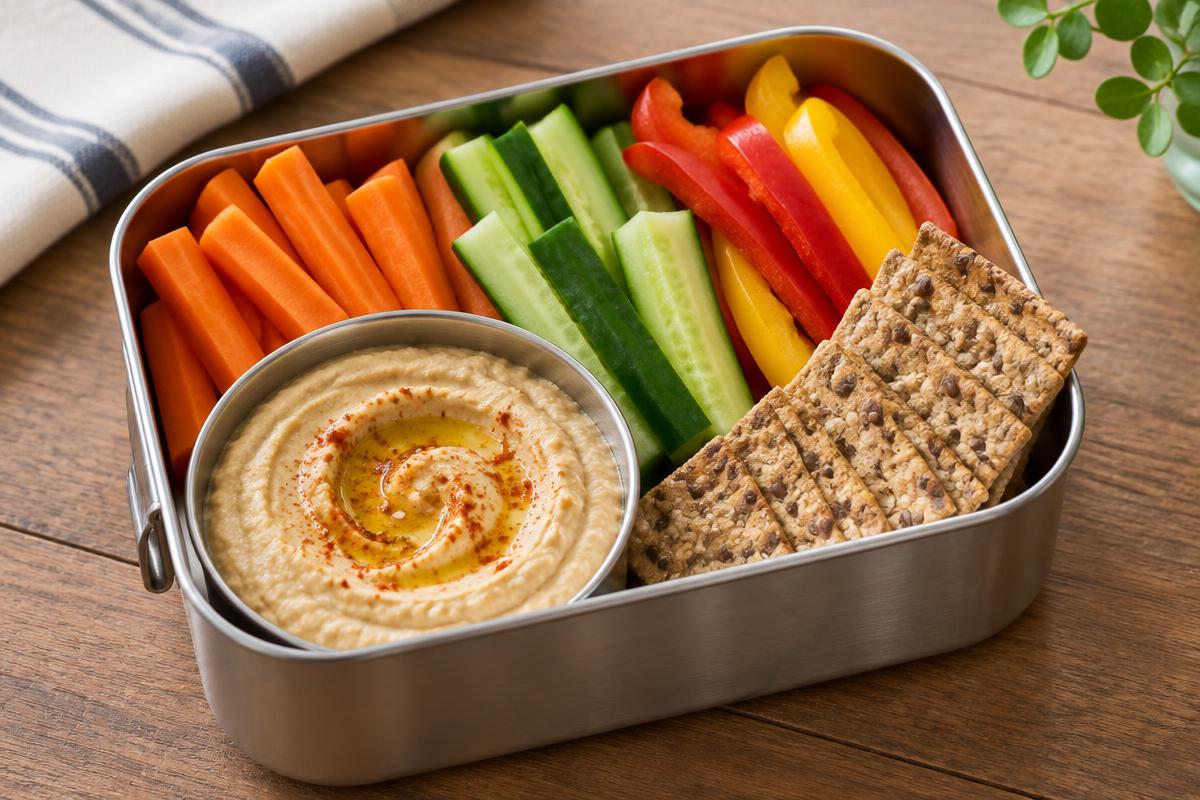
Some days lunch is better as a collection of small, familiar things. This smooth hummus gives the vegetables and pita somewhere to land, with apple slices alongside.
Original AI-assisted recipe drafts prepared for Mother When. Not kitchen-tested or nutritionally analysed; timings and household equivalents are estimates. Use doneness cues and a food thermometer where specified.
Yield: About 2 cups hummus plus 4 portions of vegetables, pita and apple
- Prep
- 20 min
- Cook
- 0 min
- Wait/chill/rest
- 30 min
- Total
- 50 min
Allow about 30 minutes for the hummus to reach 4°C (40°F) or colder in the refrigerator before packing; it may need longer. This time can be shorter if the chickpeas and other ingredients start refrigerator-cold.
Ingredients
- 360 g drained and rinsed canned chickpeas (about 2 cups; from one 540 mL can)
- 30 mL tahini (2 tablespoons)
- 30 mL lemon juice (2 tablespoons)
- 15 mL olive oil (1 tablespoon)
- 60 mL cold drinking water (¼ cup)
- 2.5 mL ground cumin (½ teaspoon)
- 1.25 mL salt (¼ teaspoon)
- 200 g carrots (about 2 medium), cut into thin sticks
- 250 g cucumber (about 1 small), cut into sticks
- 4 medium whole-wheat pitas (about 240 g total), cut into wedges
- 300 g apples (about 2 medium), cored and sliced
Metric quantities are the reference. Household measures are approximate equivalents: 1 cup = 250 mL, 1 tbsp = 15 mL and 1 tsp = 5 mL. Weights for chopped or grated foods vary with size and packing. Oven temperatures are for a conventional oven.
Equipment
- Food processor or strong blender
- Spatula
- Shallow container
- 4 compartment lunchboxes
Method
- Put the chickpeas, tahini, lemon juice, olive oil, water, cumin and salt in a food processor. Blend for 1–2 minutes, stopping to scrape down the bowl, until smooth.
- Transfer the hummus to a shallow container and refrigerate until 4°C (40°F) or colder, allowing about 30 minutes. Prepare the carrot and cucumber sticks and refrigerate them while the hummus chills.
- Divide the cold hummus between four small lidded pots, about 125 mL (½ cup) per pot. Put one pot in each lunchbox.
- Add equal portions of carrot, cucumber, pita wedges and freshly sliced apple. Keep the pita in a separate dry compartment or wrapper, close the lunchboxes and refrigerate until packing.
Make it work for your family
For a tahini-free version, leave out the 30 mL (2 tablespoons) tahini and increase the olive oil from 15 mL (1 tablespoon) to 30 mL (2 tablespoons). Blend as directed. This removes the deliberate sesame ingredient but does not establish that the meal is sesame-free; pita and other ingredients still need checking.
Allergen notes
Base recipe includes: sesame, wheat.
Tahini is sesame paste; pita contains wheat/gluten and may also contain sesame or soy. Some schools restrict sesame as well as nuts. Check labels and school policy; never describe the tahini-free variation as allergy-safe without checking every ingredient and preparation surface. For the vegan base, choose pita without milk, egg, honey or other animal-derived ingredients.
Storage and reheating
Refrigerate homemade hummus at 4°C (40°F) or below for up to 3 days; prepared vegetables keep best for 2 days. Cut apples on the day of eating for appearance. Refrigerate prepared perishables promptly and within 2 hours.
Packing for school or work
Pack chilled hummus and produce in an insulated bag with frozen ice packs sufficient to maintain 4°C (40°F) or below. Refrigerate on arrival when possible. Discard hummus or other perishable food that has spent more than 2 hours outside safe cold holding.
Freezer notes
Use the refrigerator storage guidance above. No separate freezer method is provided for this draft.
Recipe and safety notes
Busy mothers and school-age children; not infant feeding guidance.
Original untested draft; not nutritionally analysed.
Original AI-assisted wording and formulation for this collection; background safety sources did not author or test this recipe.
Read the family kitchen and source guide.
Background references
- Health Canada — Safe cooking temperatures — Internal temperature checks for poultry, ground meat, fish, egg dishes and reheated leftovers.
- Health Canada — Food safety tips for leftovers — Prompt cooling, shallow containers, a conservative 2–3 day refrigerator window, thawing and reheating.
- Health Canada — Safe school lunches — Cold and hot holding, insulated lunch bags, ice packs and school allergen policies.
- Health Canada — Safe food storage — Refrigerator and freezer temperatures and storage planning.