Quick dinners · Unpublished recipe draft
White Bean and Spinach Gnocchi Pan
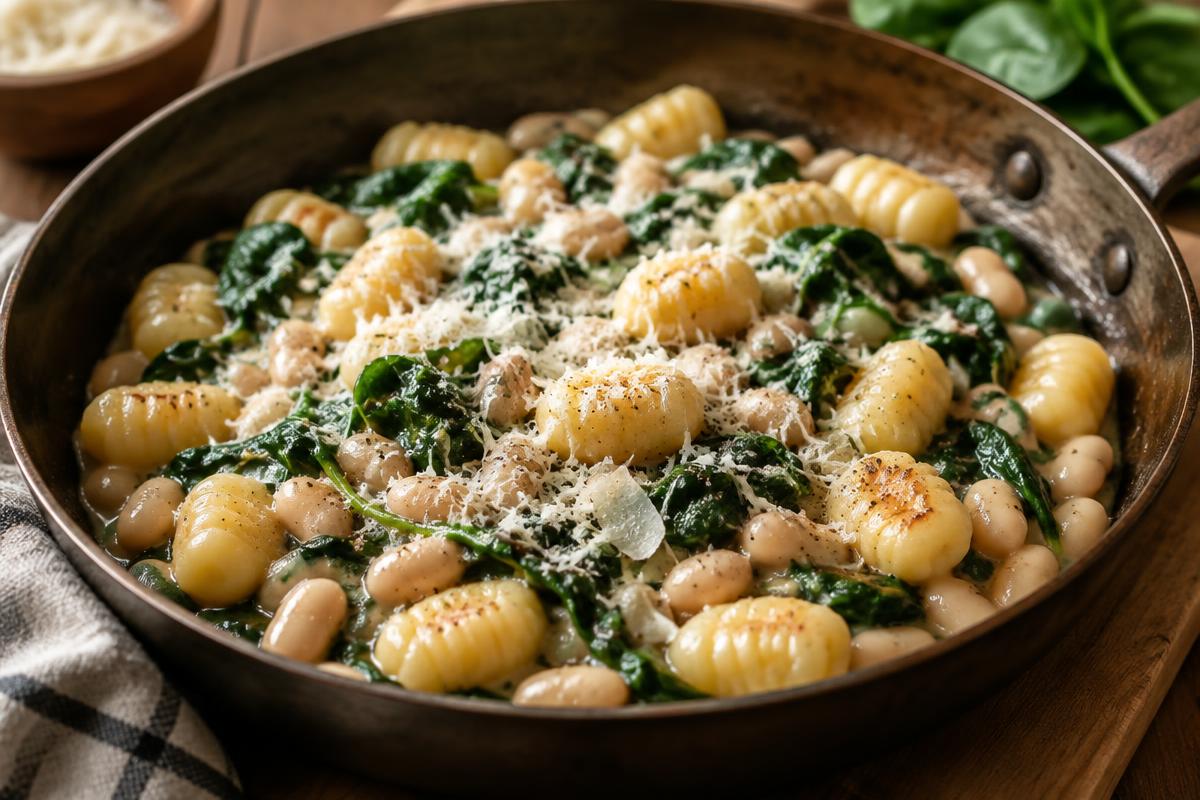
Gnocchi cooks quickly enough to make a sauce from scratch without turning dinner into a project. White beans make the pan more substantial, and frozen spinach saves the washing and chopping.
Original AI-assisted recipe drafts prepared for Mother When. Not kitchen-tested or nutritionally analysed; timings and household equivalents are estimates. Use doneness cues and a food thermometer where specified.
Yield: 4 servings
- Prep
- 8 min
- Cook
- 20 min
- Wait/chill/rest
- 0 min
- Total
- 28 min
No additional resting time.
Ingredients
- 15 mL (1 tbsp) olive oil
- 150 g (1 medium) onion, finely diced
- 2 garlic cloves (about 6 g), minced
- 400 g (about 1¾ cups) canned no-salt-added diced tomatoes, with their juice
- 375 mL (1½ cups; about 255 g) drained, rinsed canned white beans
- 250 mL (1 cup) water
- 5 mL (1 tsp) dried oregano
- 1.25 mL (¼ tsp) fine salt
- 500 g (about 1.1 lb; roughly 3 cups) shelf-stable potato gnocchi made without egg or milk
- 150 g (about 1 cup loosely packed frozen pieces) frozen chopped spinach
- 60 mL (¼ cup; about 60 g) plain yogurt
Metric quantities are the reference. Household measures are approximate equivalents: 1 cup = 250 mL, 1 tbsp = 15 mL and 1 tsp = 5 mL. Weights for chopped or grated foods vary with size and packing. Oven temperatures are for a conventional oven.
Equipment
- Large deep non-stick frying pan with lid
Method
- Heat the oil in a large deep pan over medium heat. Add the onion and cook for 5 minutes, stirring, until softened. Add garlic and cook for 30 seconds.
- Add the tomatoes and their juice, beans, water, oregano and salt. Bring to a simmer, allowing about 3 minutes.
- Stir in the gnocchi and frozen spinach. Cover and simmer for 8–10 minutes, stirring every few minutes and breaking up the spinach as it softens, until the gnocchi is tender and the spinach is fully hot. Check the gnocchi package; some brands need longer or more liquid.
- Remove the pan from the heat. Mix the yogurt with 30 mL (2 tbsp) of hot sauce in a small bowl, then gently stir it back into the pan. Serve immediately.
Make it work for your family
For a vegan version, omit the yogurt and stir in 15 mL (1 tbsp) extra olive oil at the end. Use gnocchi confirmed to contain no egg or milk; not every brand is vegan.
Allergen notes
Base recipe includes: wheat, milk.
Most potato gnocchi contains wheat; yogurt contains milk. Choose the egg-free and milk-free gnocchi specified, and check its label for other allergens. The vegan variation omits yogurt.
Storage and reheating
Divide leftovers into shallow containers and refrigerate promptly, within 2 hours, at 4°C (40°F) or colder. Use within 2–3 days. Reheat only the portion needed to 74°C (165°F); discard any uneaten reheated portion. The gnocchi will soften as it sits; add 15–30 mL (1–2 tbsp) water per portion when reheating.
Packing for school or work
For a hot lunch, reheat to 74°C (165°F) and transfer to a preheated insulated food flask that keeps it at 60°C (140°F) or hotter until eating. Otherwise pack fully chilled with frozen ice packs and reheat at school if possible.
Freezer notes
Use the refrigerator storage guidance above. No separate freezer method is provided for this draft.
Recipe and safety notes
Busy mothers and school-age children; not infant feeding guidance.
Original untested draft; not nutritionally analysed.
Original AI-assisted wording and formulation for this collection; background safety sources did not author or test this recipe.
Read the family kitchen and source guide.
Background references
- Health Canada — Safe cooking temperatures — Internal temperature checks for poultry, ground meat, fish, egg dishes and reheated leftovers.
- Health Canada — Food safety tips for leftovers — Prompt cooling, shallow containers, a conservative 2–3 day refrigerator window, thawing and reheating.
- Health Canada — Safe school lunches — Cold and hot holding, insulated lunch bags, ice packs and school allergen policies.
- Health Canada — Safe food storage — Refrigerator and freezer temperatures and storage planning.