The HRT and GLP-1 Finding Worth a Closer Look
A larger study is putting menopause hormones into the GLP-1 conversation. The findings are worth understanding, especially the difference between a pattern and proof.

You finally have a treatment conversation that feels useful. Then another headline arrives: women taking menopause hormone therapy may lose more weight on a GLP-1 medication.
It is an easy headline to turn inward. Have I missed something? Is there another reason my body is responding differently? Should I have asked about hormones months ago?
Before an interesting finding becomes another item on your personal list of things you should have done, it deserves a closer look. Researchers have found a pattern worth investigating. They have not established that adding hormone therapy will improve an individual woman's weight-loss response.
The encouraging part is that menopause is getting more attention in weight-management research. The important part is understanding exactly what that research can tell us.
The newest findings are more specific than the headline
A study announced for The Menopause Society's October 2026 meeting examined existing records for nearly 2,400 women using semaglutide and nearly 1,500 using tirzepatide. The conference abstract describes matched groups of 2,379 semaglutide users and 1,476 tirzepatide users. Participants were at least 45 and had a body mass index of at least 27. Researchers compared weight changes according to whether women also used menopause hormone therapy. Because the analysis excluded people with less than a year on treatment, it does not describe people who stopped sooner.
The association was stronger and more sustained with semaglutide. With tirzepatide, an early difference favoured hormone-therapy users, but the difference in average weight loss at the final follow-up did not reach statistical significance. One separate threshold did differ at that point: 88% of hormone-therapy users versus 84% of nonusers had lost at least 5% of starting weight. The later average and the higher thresholds did not establish a clear difference. The Society's announcement describes observational research presented at a meeting, not a randomized trial assigning women to take hormones.
That distinction prevents two shortcuts: treating every GLP-1-based medication as identical, and treating a promising conference report as a settled treatment recommendation. An uncertain final comparison also does not prove there is no effect. It means that this analysis did not establish one with sufficient statistical confidence.
A percentage needs its full sentence
The conference abstract gives a useful example: approximately 11% average weight loss at one year among semaglutide users also taking hormones, compared with 9.5% among those who were not.
Research note
Read the original conference abstract (S-1). The researchers compared existing health records. They did not randomly assign hormone therapy, so the difference does not establish that hormones caused it.
The difference is 1.5 percentage points. It is not an additional 11% of starting body weight attributable to hormones. Nor is it a promised result for everyone in either group.
For a purely mathematical illustration, 1.5% of a starting weight of 200 pounds is three pounds. This calculation is not a prediction for a woman who weighs 200 pounds. It simply makes the scale of the reported group difference easier to understand.
Whenever a headline says “more weight loss,” look for the two underlying numbers and the time point. A relative increase can sound much bigger than the absolute difference between groups.
Why researchers looked at this in the first place
The newer analysis follows smaller studies. In a 2024 study published in Menopause, researchers reviewed 106 postmenopausal women treated with semaglutide for overweight or obesity. Sixteen used hormone therapy and 90 did not. At 12 months, reported average weight loss was approximately 16% versus 12%, respectively. The association remained after statistical adjustment for selected differences between patients.
Those findings made further investigation worthwhile. They also came from a very small hormone-therapy group. Sixteen women cannot represent every experience of menopause, every medical history or every way hormone treatment is prescribed.
A separate Mayo Clinic study published in January 2026 compared 120 postmenopausal tirzepatide users with overweight or obesity. At 15 months, average weight loss was 18.7% among hormone-therapy users and 13.7% among nonusers. The researchers explicitly said their observational design could not show that hormones caused the difference.
These are separate studies, with different patients and follow-up periods. Their percentages should not be lined up as a competition or blended into one expected “hormone boost.” The newer, larger report adds information, including a less clear final tirzepatide finding.
The missing question: what else differed?
Imagine comparing two groups of women who both have a gym membership. One group also regularly sees a physiotherapist. If that group becomes stronger, physiotherapy might have helped. But the groups might also differ in injuries, available time, income, coaching or how often they actually train.
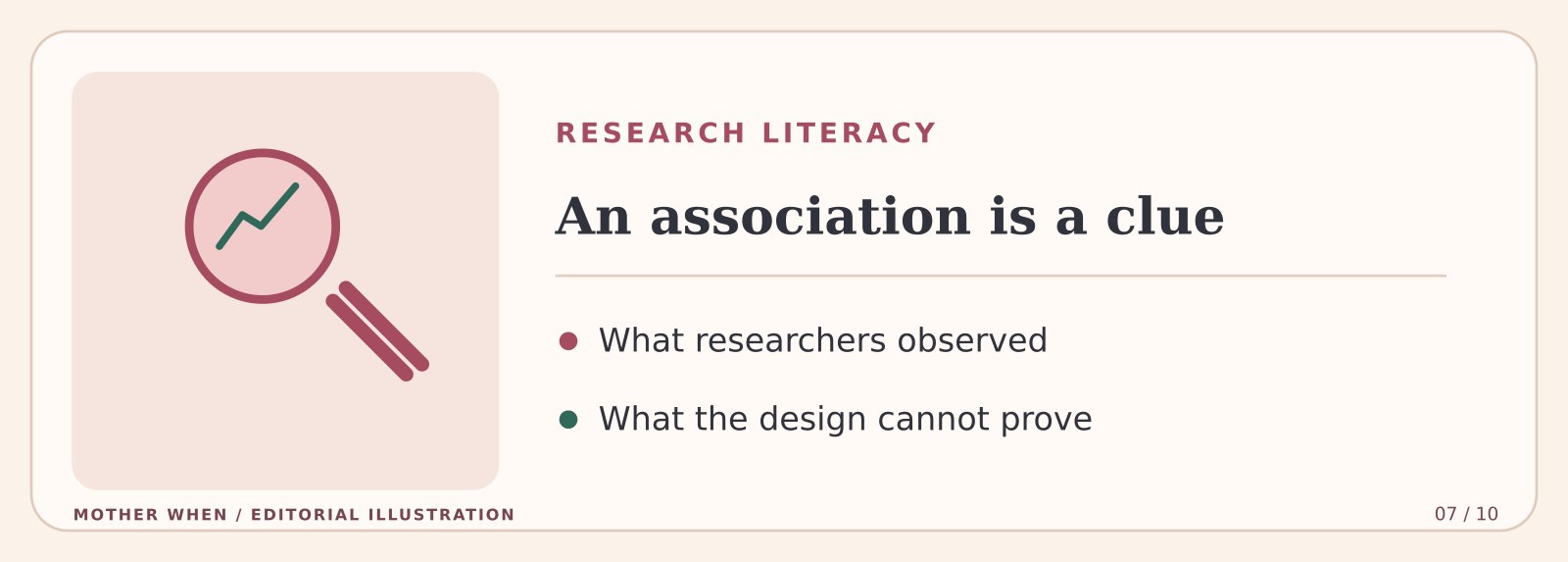
The same problem appears in health-record research. A treatment does not arrive in a person's life by random assignment. Someone sought help, an appointment happened, a clinician weighed options, and access or medical history affected the decision.
Hormone-therapy users may differ from nonusers in ways a database captures imperfectly. Researchers can adjust for recorded characteristics, but adjustment cannot fully account for something that was never measured well.
Mayo's investigators raised two possibilities: hormone users may have already had different health behaviours, or relief of menopause symptoms may have improved sleep and daily functioning, making other changes easier to sustain. Those are explanations to test, not findings that the studies proved.
Readers are also sharing: That $140 Peptide Vial Has Some Explaining to Do
This is why the careful phrase “associated with” matters. It leaves room for a real biological effect while acknowledging other plausible explanations.
A plausible mechanism is a starting point
Hormones and appetite signalling do not operate in separate compartments. The Society's announcement points to preclinical research suggesting interaction between estrogen and GLP-1 signalling. That gives scientists a reason to investigate the combination.

But a proposed pathway does not tell a clinician who will benefit, how much benefit to expect, or whether the overall balance of benefits and harms improves. Research can make biological sense and still produce a smaller, inconsistent or different effect when tested in people.
It is tempting to fill those gaps with a tidy explanation about “fixing hormones.” The evidence is not that tidy. Women also differ in age, reproductive stage, symptoms, other conditions and treatment history. A theory has to survive those differences before it becomes a dependable clinical recommendation.
Menopause does not make effective treatment impossible
There is another finding worth keeping beside the combination headlines. A 2025 analysis of the SURMOUNT trials found substantial weight reduction with tirzepatide compared with placebo across premenopausal, perimenopausal and postmenopausal groups.
This was a later analysis of randomized medication trials, rather than a trial designed to test hormone therapy. It cannot answer whether adding hormones helps. It does show why the conversation should not become “women need HRT before weight treatment can work.” Menopause stage alone did not erase the medication's benefit in those trial populations.
No study average describes every participant. A woman whose response is slower than someone else's has not failed an experiment or missed a moral requirement.
What would make the combination evidence stronger?
The next useful research would prospectively compare appropriate treatment groups, measure menopause symptoms and other relevant factors, and follow both benefits and adverse effects. Random assignment, where medically and ethically appropriate, would better separate treatment effects from pre-existing differences.
Representation matters too. Research needs enough women from different racial and ethnic backgrounds, with varied health histories, to examine whether results travel beyond a particular clinic population. A study about “women” does not automatically answer every woman's question equally well.
Useful outcomes should also extend beyond pounds: daily functioning, strength, treatment tolerability and health measures matter. More weight loss is not automatically the most important result for every patient.
For now, the findings support a better-informed conversation, not a universal combination prescription. Hormone therapy should be considered for appropriate menopause-related reasons; the study announcement itself cautions against treating weight loss as an indication.
You can welcome the research without turning it into another demand on your body. The useful development is that scientists are asking more relevant questions about midlife women. You do not have to supply the missing answers yourself.
This article provides general education, not personal medical advice. Qualified medical review is pending.
Sources
Mayo Clinic tirzepatide cohort, published paper. Retrospective comparison; 15-month estimates.
The Menopause Society official 2026 late-breaking abstracts, S-1. Primary conference abstract, not a full peer-reviewed paper.
- The Menopause Society: Hormone Therapy May Increase Weight Loss Effectiveness of GLP-1s. October 2026 meeting announcement; observational cohort report, not a full randomized combination trial.
- BlackDoctor: Could Menopause Hormone Therapy Help Black Women Get Better Results With GLP-1 Weight Loss Drugs?. November 10, 2026. User-supplied secondary source for topic inspiration. The numerical example was checked against the conference abstract.
- Hurtado and colleagues: Weight loss response to semaglutide in postmenopausal women with and without hormone therapy use. Menopause, 2024;31:266–274. DOI: 10.1097/GME.0000000000002310. Retrospective cohort.
- Mayo Clinic: New study links combination of hormone therapy and tirzepatide to greater weight loss after menopause. January 22, 2026. Research institution's account of its published observational study; causal limits stated by investigators.
- Tchang and colleagues: Body weight reduction in women treated with tirzepatide by reproductive stage. Obesity, 2025;33:851–860. DOI: 10.1002/oby.24254. Post hoc analysis of SURMOUNT trials; not an HRT randomization study.
Read next
 Health & FitnessTesamorelin and the Waistband Question: Who Was Studied, and What Changed?Tesamorelin results come from a specific clinical group. Here’s who was enrolled, what changed and why that matters before applying it to midlife weight.
 WellnessA GLP-1 and Hormone Therapy? Questions to Ask Before You Combine ThemThe best combination conversation begins with your symptoms and goals. These practical questions help connect menopause care, weight treatment and the medicines you already take.
 Health & FitnessSemaglutide or Tirzepatide After 50? What the Studies Actually Tell WomenTirzepatide produced greater average weight loss in a direct trial, but age, medical history, strength and the outcome being studied all matter. Here is how to read the comparison without mistaking averages for personal promises.
 WellnessWould Menopausal Hormone Therapy Help With the Week You’re Actually Having?You don’t have to know whether you want hormones before you book the visit. Bring the symptom you want help with, what’s changed and these questions.
Get the weekly digest
One email a week. Unsubscribe anytime. Privacy Policy
More in Health & Fitness

The CagriSema Headline Said 25%. Here’s the Part Women Should Read Twice.
A 25% weight-loss headline sounds straightforward. Who was counted, what the researchers assumed and what they didn’t test make it a much more useful story.
The Weight That Won’t Move After Kids: What Semaglutide Studies Can—and Can’t—Tell You
A plateau doesn’t tell you whether medication is right for you. Start with who the semaglutide trials studied, what they measured and what to ask a prescriber.
Discussion
Loading comments…