A GLP-1 and Hormone Therapy? Questions to Ask Before You Combine Them
The best combination conversation begins with your symptoms and goals. These practical questions help connect menopause care, weight treatment and the medicines you already take.

The questions tend to arrive together, even when the appointments do not.
You want to discuss the nights you wake drenched, the changes around your waist, the treatment your friend says helped her, and whether anything you are already taking could complicate the next step. The appointment is short. Your notes app is becoming a medical filing cabinet.
A useful conversation about menopause hormone therapy and GLP-1-based medicines starts with a simple principle: each treatment needs a clear purpose, and someone needs to see the whole plan.
For some women, both treatments may be appropriate. A promising weight-loss headline cannot determine that. The practical question is how a clinician would assess your symptoms, health history, existing medicines and goals together.
Start with the problem you want help solving
Before discussing a combination, describe what has changed and what is making life harder. “I want to feel better” is valid. A few concrete details make it easier to work with.
Perhaps night sweats interrupt sleep. Perhaps you are worried about weight-related health problems. Perhaps vaginal symptoms are affecting comfort, while a completely different concern is driving the weight-treatment discussion.
These concerns do not necessarily require the same treatment. The Menopause Society explains that systemic hormone therapy can treat bothersome hot flashes and night sweats, while low-dose vaginal estrogen is used for local symptoms. A vaginal treatment is not interchangeable with systemic HRT.
A useful opening question is: “What are we treating with each medicine, and what improvement would tell us it is helping?”
That question gives the conversation a direction beyond assembling a popular combination.
Ask whether each treatment makes sense on its own
Hormone therapy is not prescribed solely to increase weight loss. Its potential benefits need to be weighed against the individual's risks and reasons for treatment.
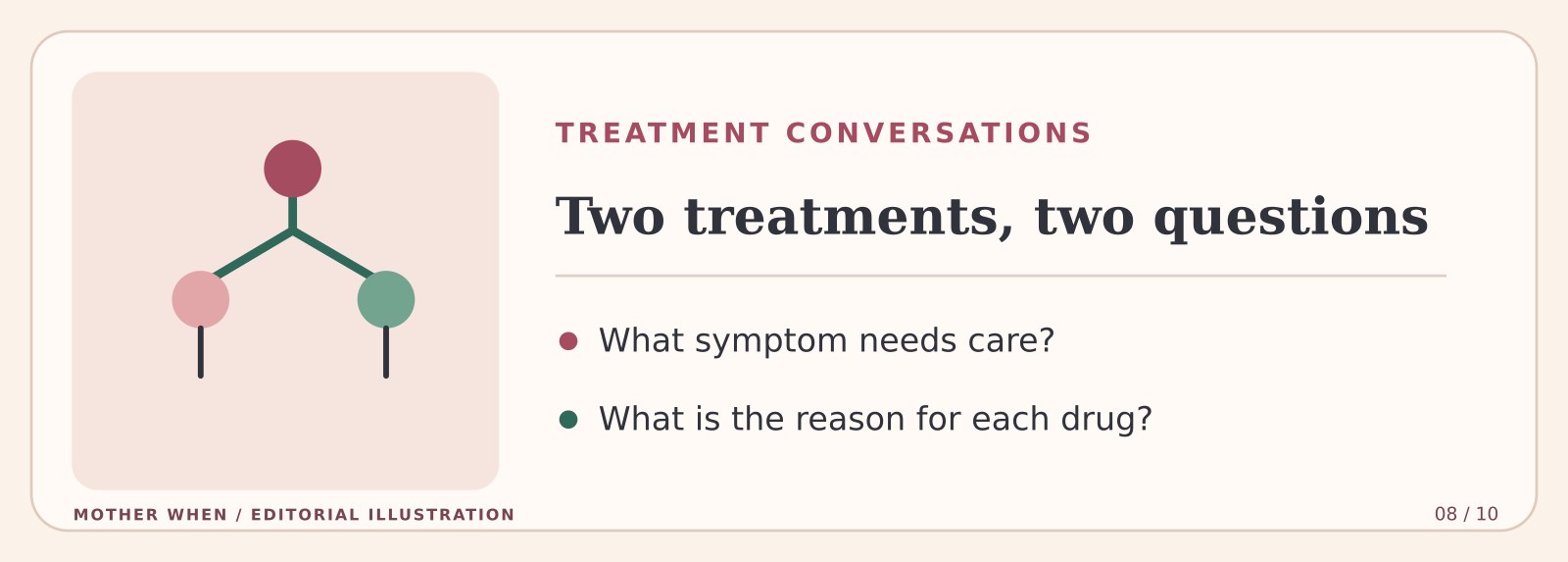
A GLP-1-based medicine also needs its own medical rationale. In Canada, obesity-treatment guidance emphasizes health complications, appropriate assessment and individual goals. Feeling uncomfortable in your clothes is worth discussing, but it does not by itself determine medication eligibility.
Ask: “Would you recommend each of these treatments for me if we had never seen a headline about using them together?”
Research note
Read the British Menopause Society’s clinician guidance. This UK resource flags a possible issue with oral hormone absorption. Direct evidence is limited, so it’s a question for a medication review rather than a reason to change anything yourself.
There may be two clear indications. There may be one. There may be another approach that better addresses your main problem. A thoughtful answer should explain the reasoning without making you feel that every midlife change requires a prescription.
Put the combination research in its proper place
Small observational studies have reported greater weight loss among some women using hormone therapy alongside semaglutide or tirzepatide. For example, the published 2024 semaglutide study compared existing patient records rather than randomly assigning hormone treatment.
That evidence can inform questions. It cannot establish that hormones caused the extra weight loss, identify a guaranteed responder or replace a safety assessment.
For this appointment, the most productive follow-up is: “Does this research change your recommendation for my circumstances, or does it mainly identify something researchers still need to test?”
You do not need to argue against promising research. You deserve to know which part is established care and which part is still an open question.
Bring the actual medication list
“The injection” and “my hormones” leave out details that can matter. Bring the names of prescription medicines, nonprescription products and supplements, how you take them, and who prescribed them. Include tablets, patches, vaginal treatments and contraception, even if different clinicians manage them.

Photographs of the packaging can help if remembering names is difficult. Note recent changes and symptoms that appeared around the same time. Do not alter a regimen to prepare for the appointment.
A helpful question is: “Can you or my pharmacist review the complete list, rather than only the two medicines we are discussing today?”
This makes coordination possible. It also saves you from having to decide which details belong to which specialist.
Readers are also sharing: Your Copper-Peptide Serum Has a Science Story. Let’s Get Into It
Ask about oral hormones and absorption
GLP-1-based treatments can slow stomach emptying. That raises a practical question about medicines taken by mouth, including the progestogen component of some HRT regimens.
The British Menopause Society's current clinician guidance discusses a potential concern about reduced oral progestogen absorption. It also makes clear that direct evidence about HRT absorption, bleeding patterns and endometrial risk remains lacking. Precautionary recommendations should not be mistaken for proof that every combination fails.
For women with a uterus using systemic estrogen, appropriate protection of the uterine lining matters. Ask: “Does my HRT formulation need reviewing when this medicine is started or changed?”
The answer may involve the route of treatment, follow-up or another adjustment. It belongs with the prescriber. Do not change hormone amounts or switch products based on an online article. Report new or unexpected vaginal bleeding so it can be assessed rather than automatically blamed on a medication interaction.
Make room for your medical history
A conversation about hormone therapy should include relevant personal and family history. Previous blood clots, certain cancers, liver disease, cardiovascular disease and unexplained bleeding can affect whether systemic hormones are appropriate. The Menopause Society's patient guidance recommends an individualized benefit-risk discussion.
The weight-treatment assessment has its own considerations, including other medicines and previous side effects. Ask what in your history changes the options, and whether specialist advice would help.
You should not have to interpret a long contraindication list alone. The goal is an explanation you understand: why an option is suitable, why another is less suitable, or what needs clarification before deciding.
Do not let contraception disappear from the discussion
Irregular periods do not necessarily mean pregnancy is impossible. HRT is not contraception.
Some medicines require specific contraceptive precautions. The NHS Specialist Pharmacy Service highlights an interaction between tirzepatide and oral contraceptives, and advises reviewing pregnancy considerations with GLP-1 treatment.
If pregnancy is possible or planned, say so before treatment decisions. Ask: “Is my current contraception appropriate with this exact medicine, including when treatment changes?”
This is a separate issue from using progesterone to protect the uterine lining. Similar-sounding hormone names can serve different purposes, which is another reason the complete medication list matters.
Agree on what happens between appointments
A plan should say whom to contact about side effects and when the next review will happen. Ask which symptoms can be managed routinely and which need prompt or urgent assessment.
Digestive side effects can occur with GLP-1 medicines. Severe, persistent abdominal pain, or vomiting that prevents you from keeping fluids down, warrants urgent medical advice rather than waiting for the next scheduled check. Official patient safety guidance explains the concerns about pancreatitis and dehydration.
The review should also leave room for eating adequately, strength, daily functioning and how manageable the treatment feels. Ask whether dietitian support would help. Dietitian-developed resources can support that discussion without turning your family meals into another perfection project.
Finally, ask about the longer-term plan, including affordability and what happens if treatment needs to change. Canada's guideline treats obesity medication as a potential long-term strategy, not a brief deadline-driven fix.
You can leave with a sensible next step rather than a decision on everything. A clear explanation, a reviewed medication list and an agreed follow-up are useful outcomes. Your appointment should help you understand your options, not send you home with more pressure to get your body “right.”
This article provides general education and questions for discussion, not individualized treatment advice. Qualified medical review is pending.
Sources
- The Menopause Society: Hormone Therapy. Patient guidance on systemic/local therapy, benefits, risks and individual assessment.
- Obesity Canada: Pharmacotherapy for Obesity Management in Adults, 2025 update. Canadian clinical practice guidance on individual goals, eligibility, medication selection and long-term care.
- Hurtado and colleagues: Weight loss response to semaglutide in postmenopausal women with and without hormone therapy use. Menopause, 2024;31:266–274. DOI: 10.1097/GME.0000000000002310. Retrospective observational research.
- British Menopause Society: Use of incretin-based therapies in women using HRT. October 2026 clinician tool, hosted in November. UK professional guidance; its precautionary HRT recommendations are not evidence of a proven interaction in every patient and should be adapted to local clinical care.
- NHS: About hormone replacement therapy. HRT purpose and contraception context.
- NHS Specialist Pharmacy Service: Considerations and interactions with GLP-1 receptor agonists. Medication review, pregnancy and contraceptive considerations; HRT evidence gaps.
- MHRA: GLP-1 medicines for weight loss and diabetes, what you need to know. Public patient-safety information.
- British Dietetic Association: Staying healthy when taking medications for obesity. Dietitian-developed public resources and individualized support.
Read next
 WellnessThat “99% Pure” Peptide Label Is Doing a Lot of WorkA polished label and a laboratory report can look reassuring. Here is what they actually tell you, and what they cannot.
 Health & FitnessThe HRT and GLP-1 Finding Worth a Closer LookA larger study is putting menopause hormones into the GLP-1 conversation. The findings are worth understanding, especially the difference between a pattern and proof.
 WellnessThe Menopause Appointment You Keep Putting Off: How to Make It CountA little preparation can help you leave a menopause appointment with clearer answers, realistic options and a follow-up plan. Here is how to make room for the symptoms you keep brushing aside.
 Health & FitnessSemaglutide or Tirzepatide After 50? What the Studies Actually Tell WomenTirzepatide produced greater average weight loss in a direct trial, but age, medical history, strength and the outcome being studied all matter. Here is how to read the comparison without mistaking averages for personal promises.
Get the weekly digest
One email a week. Unsubscribe anytime. Privacy Policy
More in Wellness

Menopause Hormone Therapy Is Back in the Headlines. What Actually Changed?
The latest menopause guideline is more specific than the headlines. Here’s what it says about hot flashes, sleep and mood, and what the U.S. update means for Canadian readers.

Your Heart Health History Didn’t Start at Menopause
Your pregnancy history can matter long after the postpartum visit. Here’s what a new U.S. heart-health framework is asking clinics to remember, and what Canadian guidance already says.
Discussion
Loading comments…