That $140 Peptide Vial Has Some Explaining to Do
An expensive label can feel reassuring, and a bargain can feel risky. Neither feeling establishes what is in a product or whether it belongs in your care.
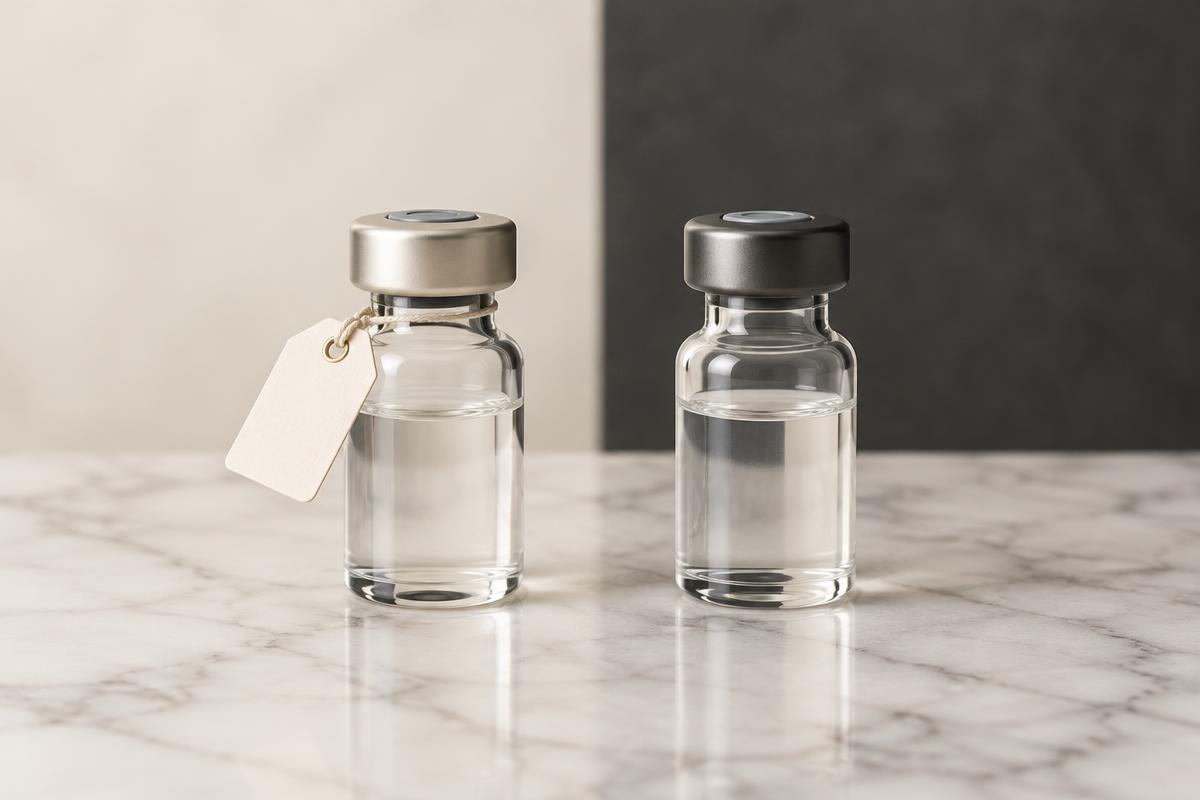
Suppose two listings use the same compound name. One says $40; the other says $140. These are hypothetical prices, but the familiar mental arithmetic is real: is the expensive one better, or am I paying for a nicer website?
When you already compare grocery totals and school fees, wanting an answer makes sense.
The price alone cannot give you one.

What you cannot conclude from a price tag
A low price does not prove that a seller skipped a manufacturing step. A high price does not prove purity, safety or effectiveness. Without evidence about the actual products, either conclusion would be a guess.
For legitimate laboratory procurement, comparisons need more detail than a compound name and an amount on a label. Researchers may need to consider the exact material, lot-specific documentation, analytical methods and whether the product meets the study’s requirements.
Even the amount needs careful interpretation: chromatographic purity and actual peptide content are distinct measurements. USP researchers: Reference Standards to Support Quality of Synthetic Peptide Therapeutics
For personal health, change the comparison
A research vial and a prescribed medicine are not two price points for the same purchase. Chemical identity does not establish that products share the same quality controls, clinical evidence or intended use.
For a health decision, you need evidence about benefits, harms and suitability for your situation. A laboratory catalog listing cannot supply a personalized assessment.
If a treatment has been proposed for you, ask for costs you can actually plan around:

- What is the diagnosis or reason for treatment?
- Is there an approved option that fits my situation?
- What will consultations, medication and follow-up cost?
- Are there appropriate lower-cost or insurance-covered options?
- What happens if it does not help or causes side effects?
If a prescription is part of the plan, ask the clinician or pharmacist to help compare appropriate options. A premium price is not a clinical result.
You can be careful without becoming suspicious of everything
There is no need to assume that every bargain is dishonest or every premium brand is exploiting you. Ask for the information that fits the purchase, then decide whether you have enough to proceed.

For your own health, a budget conversation with a clinician or pharmacist is a more useful next step than trying to calculate safety from two price tags.
The goal is a decision you understand, including what you are paying for and what remains unknown.
Research worth reading
- Wilding et al.: STEP 1 randomized trial of semaglutide. Clinical context: a controlled trial gives information that a price tag cannot. Results for one prescription medicine do not establish the value or safety of a research vial.
General education, not personal medical advice. Discuss health concerns and treatment decisions with a qualified clinician. Selected research examples illustrate encouraging findings and their limits; they are not a complete review of benefits and risks.
Read next
 WellnessThat “99% Pure” Peptide Label Is Doing a Lot of WorkA polished label and a laboratory report can look reassuring. Here is what they actually tell you, and what they cannot.
 WellnessOne Word, Four Very Different Products: The Peptide Mix-UpThe same word appears in skincare, prescription medicine and research catalogs. Here is a simple way to keep the categories straight.
 Health & Fitness7 Questions to Ask Before Peptide Hype Gets Your Credit CardA useful checklist for the late-night scroll, including the reassuring phrases that do not prove a product is safe.
Get the weekly digest
One email a week. Unsubscribe anytime. Privacy Policy
More in Health & Fitness

The CagriSema Headline Said 25%. Here’s the Part Women Should Read Twice.
A 25% weight-loss headline sounds straightforward. Who was counted, what the researchers assumed and what they didn’t test make it a much more useful story.

The HRT and GLP-1 Finding Worth a Closer Look
A larger study is putting menopause hormones into the GLP-1 conversation. The findings are worth understanding, especially the difference between a pattern and proof.
Semaglutide or Tirzepatide After 50? What the Studies Actually Tell Women
Tirzepatide produced greater average weight loss in a direct trial, but age, medical history, strength and the outcome being studied all matter. Here is how to read the comparison without mistaking averages for personal promises.
Discussion
Loading comments…