One Word, Four Very Different Products: The Peptide Mix-Up
The same word appears in skincare, prescription medicine and research catalogs. Here is a simple way to keep the categories straight.

You see the word on a serum before work, hear it in a podcast on the school run, and meet it again in a headline about prescription medicine.
By dinner, it can feel as if everyone is talking about the same thing. They may be talking about entirely different products.
One scientific word, several different conversations
Peptides are chains of amino acids, the building blocks also found in proteins. Researchers and clinicians have worked with peptide-based medicines for many years. The category is broad; belonging to it says little on its own about a product’s benefits or risks. Scientific review: Therapeutic peptides, current applications and future directions
Think of “peptide” as the beginning of a description. The rest of the sentence matters.
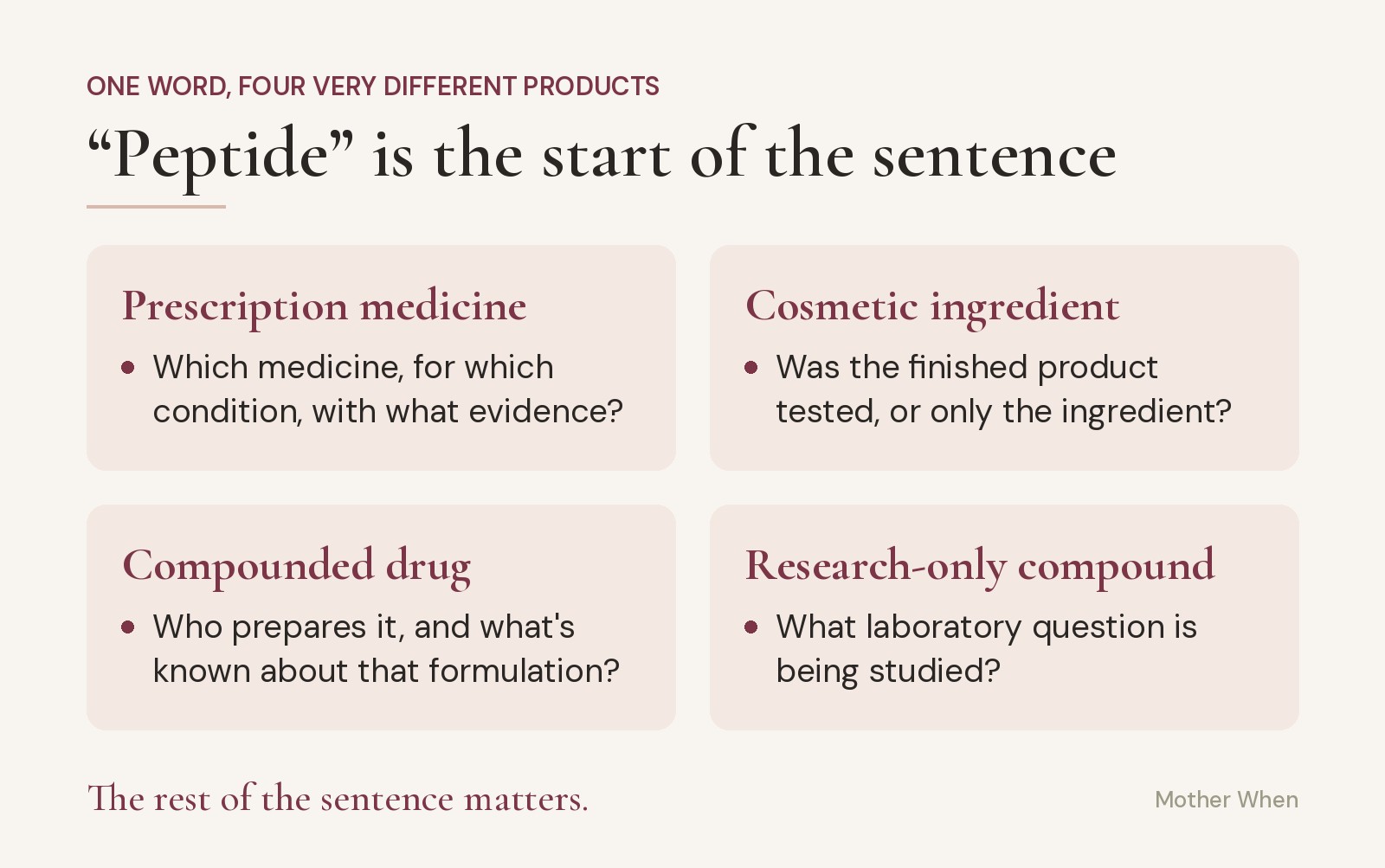
Prescription medicine: Which exact medicine, for which condition, with what evidence and supervision?
Cosmetic ingredient: Which finished product, for what cosmetic purpose? A study of an ingredient is not automatically a study of the serum on your shelf.
Compounded drug: Why does this patient need it, who is preparing it, and what is known about that formulation?
Research-only compound: What laboratory question is being investigated? Availability in a research catalog does not establish suitability for personal use.
The encouraging part is specific
Some peptide medicines have substantial human evidence. The large STEP 1 semaglutide trial is one example. Its positive findings belong to that medicine and population, with its recorded adverse effects, not to every peptide in a catalog. Wilding et al.: STEP 1 randomized trial of semaglutide

Other research is earlier: a signal in cells, an animal experiment or a small human pilot. Those stages can be scientifically exciting without being equally ready to guide personal treatment.
A three-line note for the next claim
Before saving a post, write:
- The exact product being discussed.
- The result it is supposed to produce.
- The study or official source offered to support that result.

If one line stays blank, you have found your next question. If the source studies a different product or a different route of use, the claim needs another look.
You do not need to memorize every compound name. Keeping the categories separate is already a useful skill, especially when the rest of your day has enough tabs open.
Research worth reading
- Scientific review: Therapeutic peptides, current applications and future directions. Scientific review: a broad introduction to peptide drug development, including established applications and unresolved challenges. This is a review, not a new clinical trial.
General education, not personal medical advice. Discuss health concerns and treatment decisions with a qualified clinician. Selected research examples illustrate encouraging findings and their limits; they are not a complete review of benefits and risks.
Read next
 WellnessThat “99% Pure” Peptide Label Is Doing a Lot of WorkA polished label and a laboratory report can look reassuring. Here is what they actually tell you, and what they cannot.
 WellnessThere’s a Peptide for That? What the Science Is ShowingFrom metabolic medicines to skin research, some peptides have remarkable human data. Here’s where the most exciting evidence actually starts.
 Beauty & Self CareSkin Care After 35: What Matters and What Is Marketing?Your face hasn’t missed a deadline. Learn which basics earn their place, what peptide claims mean, and when another bottle isn’t the answer.
 Health & FitnessGLP-1s, Weight and the Pressure to Find an AnswerCurious about GLP-1s, but tired of everyone having an opinion? Here are the questions that belong in your decision—not theirs.
Get the weekly digest
One email a week. Unsubscribe anytime. Privacy Policy
More in Wellness

A GLP-1 and Hormone Therapy? Questions to Ask Before You Combine Them
The best combination conversation begins with your symptoms and goals. These practical questions help connect menopause care, weight treatment and the medicines you already take.

The Menopause Appointment You Keep Putting Off: How to Make It Count
A little preparation can help you leave a menopause appointment with clearer answers, realistic options and a follow-up plan. Here is how to make room for the symptoms you keep brushing aside.

Menopause Hormone Therapy Is Back in the Headlines. What Actually Changed?
The latest menopause guideline is more specific than the headlines. Here’s what it says about hot flashes, sleep and mood, and what the U.S. update means for Canadian readers.
Discussion
Loading comments…