Health Metrics Without Another Obsession
Your watch has plenty of numbers. Which ones actually help? A smaller dashboard can make room for better questions—and less checking.
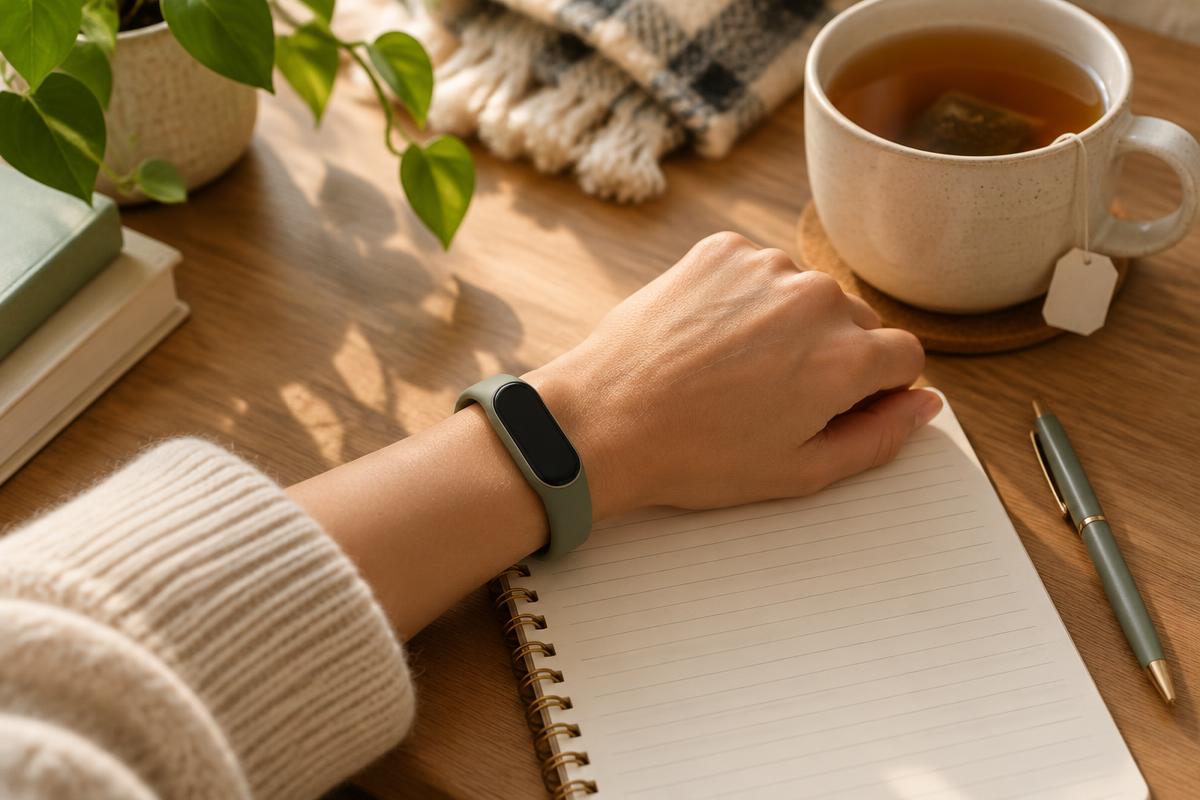
Your watch buzzes while you are scraping dried oatmeal from a bowl. It has thoughts about your recovery. Your phone has thoughts about your steps. A child is shouting that the socks feel wrong, and your sleep score has already announced that today is off to a disappointing start.
You felt reasonably human until you looked at the screen. Now you are mentally rearranging bedtime, lunch, and the school run to satisfy a dashboard that has never packed a backpack.
Health information can help. But when every number demands a response, your body becomes another inbox. The useful question is not how much you can track. It is what the information will let you do differently.
The quick read:
- Start with one question, not another device.
- Keep prescribed monitoring separate from optional wellness scores.
- Give every optional metric a purpose, a review date, and an exit.
What decision will this number change?
Imagine two versions of a step count. In one, it reminds you that a desk-heavy morning could use a walk. In the other, you pace the kitchen at bedtime because the ring is not closed. Same technology; very different relationship.
Before enabling a feature, finish this sentence: if I learn this, I will consider doing that. If the second half is missing, the metric may be interesting without being useful. You are allowed to leave interesting information uncollected.
Medical monitoring is a separate category. If your clinician has asked you to record blood pressure, blood glucose, or another measurement, follow that plan. Ask when to measure, which changes require a call, and who will review the results. Do not stop prescribed monitoring because you are simplifying optional tracking.
For everything else, begin with a question small enough to answer. Does walking at lunch help me feel less stiff? Am I repeatedly skipping a meal on meeting-heavy days? A notebook may do the job without a subscription or a charging cable.
The target is not always what the internet says
Ten thousand steps sounds official because you have heard it so often. But the CDC's adult activity guidance is framed around at least 150 minutes of moderate-intensity activity each week, plus muscle-strengthening activity on two days. It does not require everyone to complete a particular daily step count.
A second, easily missed fact from the same guidance: you can break activity into smaller chunks. That means the walk before pickup is not disqualified because it fails to resemble a workout. Some activity is better than none, and your starting point matters.
Use those recommendations as context, not a fresh collection of boxes to fail. If your present week includes almost no movement, a short walk you can repeat may tell you more about building a habit than a large goal you keep renegotiating.
Nor does every meaningful improvement make a dramatic graph. Carrying groceries with less effort or noticing that a familiar hill feels easier may matter to you. Write that down if it helps. Leave it unmeasured if measuring steals the pleasure.
Your sleep score cannot examine you
A consumer device estimates sleep from the signals it can detect. The screen may look authoritative, but an attractive chart is not the same as a clinical assessment, and different features have different evidence behind them.
In its 2018 position statement, the American Academy of Sleep Medicine cautioned that consumer sleep technology lacking appropriate validation and clearance should not be used to diagnose or treat sleep disorders 1. That statement is not a current product-by-product verdict; it is a useful reason to ask what a particular feature has actually been validated to do.
Readers are also sharing: When the Group Chat Recommends BPC-157: What the Evidence Actually Says
Your own experience still belongs in the picture. A good score should not dismiss ongoing exhaustion. A poor score does not require you to spend the day expecting to unravel. If persistent sleep problems or daytime tiredness are affecting you, check in with a clinician rather than asking the watch to explain everything.
Related: 7 Questions to Ask Before Peptide Hype Gets Your Credit Card: the seven smart questions our readers use to size up any peptide headline before it reaches their cart.
When tracking makes you anxious, notice the behavior rather than debating whether the technology is good or bad. Are you checking repeatedly for reassurance? Does one reading decide your mood? Are you changing food or exercise mainly to satisfy the display? Those are reasons to reconsider optional features, not invitations to track your anxiety more thoroughly.
Build a dashboard with room to breathe
Try three lines on paper. The first is a health action agreed with your clinician, if you have one. It might say to bring a log to an appointment. If there is no current task, leave the line blank. Empty space is not a medical oversight.
The second is one habit you can influence: walking after lunch, making time to eat, or doing a short strength session that suits your circumstances. A tick is enough. You do not need to turn lunch into a performance indicator.
The third is a brief observation about functioning. Write that the stairs felt easier, you felt unusually tired, or your headache returned. Notes can make an appointment more useful without pretending to establish a diagnosis.
The NIMH's self-care guidance notes that even small amounts of exercise add up and suggests making sleep a priority. It also specifically recommends deciding what must get done now and what can wait. That last instruction deserves equal billing with the walking advice.
Review optional notes once a week, not every time you have a doubtful moment. Look for one practical clue. If lunches vanish on office days, the intervention may be protecting a break rather than upgrading an app.
Try this tonight: retire one number
- Choose your question. Write one sentence about something you want to understand or improve. Keep it specific enough to guide an action.
- Sort your tracking. Mark what is medically advised and what is optional. Keep the clinical plan intact; ask for clarification if needed.
- Mute one optional alert. Start with the notification that interrupts you without leading to a useful choice.
- Set a review and an ending. Try your small record for two weeks, then decide whether to continue, simplify, or stop. You do not owe the experiment a perfect streak.
If checking is becoming distressing, especially around eating or exercise, discuss it with a qualified professional. The goal is not to win at being relaxed about health. It is to have information serve your life instead of supervise it.
Tomorrow morning, the oatmeal may still be welded to the bowl. The socks may still be wrong. Your watch can stay quiet while you handle the actual morning. A helpful number earns its place by making a decision clearer, not by making you feel smaller.
Read next
 Health & FitnessKnee Pain Interrupted Her Return to Running. What Does BPC-157 Research Actually Tell Us?Knee pain is immediate. Whether BPC-157 research answers it is a separate, narrower question—here’s what the animal studies and one small human report found.
 Health & FitnessWhy Weight Changes After 35 Feel So PersonalA tight waistband can bring a whole history into the room. The science of midlife weight offers a kinder starting point than self-blame.
 Health & FitnessStrong Mothers: Training for Real LifeGroceries are heavy. Life is awkward. A simple strength plan can help you practice for both—without turning every workout into a test.
 Health & FitnessGLP-1s, Weight and the Pressure to Find an AnswerCurious about GLP-1s, but tired of everyone having an opinion? Here are the questions that belong in your decision—not theirs.
Further research
Peptide research
Around the web
- Peptides: Types, Health Benefits, and Uses — WebMD
- Trends in peptide drug discovery — Nature Reviews Drug Discovery
- Therapeutic peptides: historical perspectives, current development trends, and future directions — Bioorganic & Medicinal Chemistry
Get the weekly digest
One email a week. Unsubscribe anytime. Privacy Policy
More in Health & Fitness
The CagriSema Headline Said 25%. Here’s the Part Women Should Read Twice.
A 25% weight-loss headline sounds straightforward. Who was counted, what the researchers assumed and what they didn’t test make it a much more useful story.

The HRT and GLP-1 Finding Worth a Closer Look
A larger study is putting menopause hormones into the GLP-1 conversation. The findings are worth understanding, especially the difference between a pattern and proof.
Semaglutide or Tirzepatide After 50? What the Studies Actually Tell Women
Tirzepatide produced greater average weight loss in a direct trial, but age, medical history, strength and the outcome being studied all matter. Here is how to read the comparison without mistaking averages for personal promises.
Discussion
Loading comments…